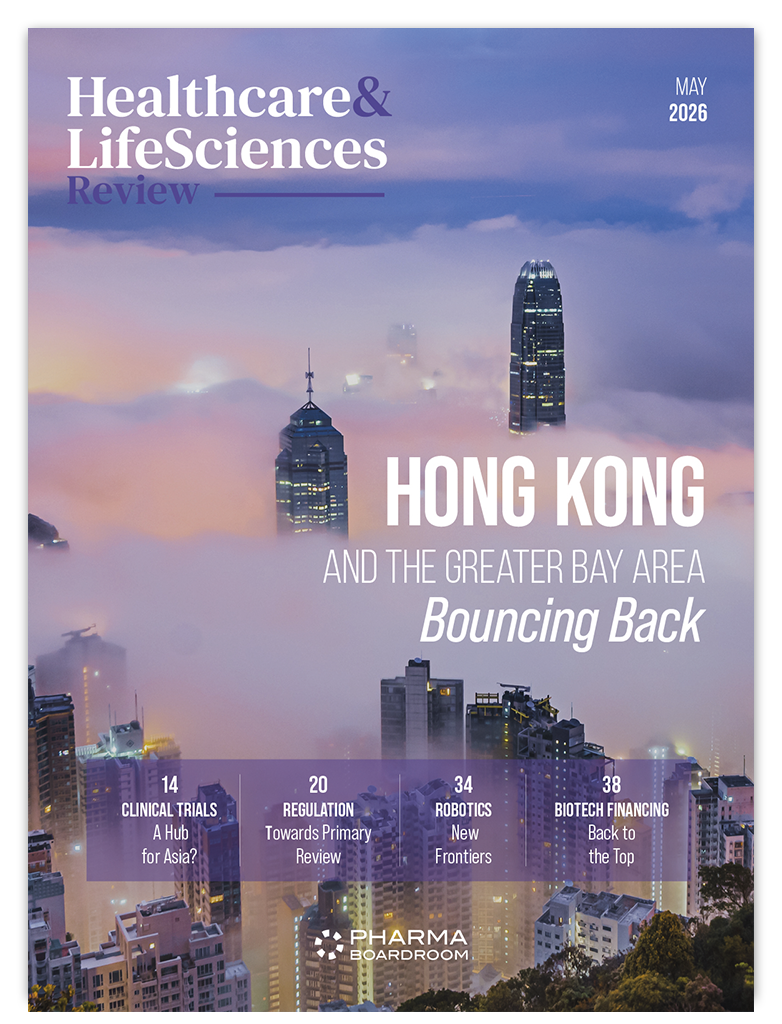
Hong Kong’s biotech capital market has completed one of the more dramatic reversals in recent years. After a brutal two-year drought in which valuations collapsed, liquidity evaporated, and companies were forced to sell assets just to survive, the market roared back in 2025 – reclaiming the top global position for IPO fundraising, with the Hang Seng Biotech Index up 64.5 percent from 2024 and outperforming NASDAQ by a wide margin.
The causes are structural, not cyclical: a reformed listing framework, the return of many international investors, and – most importantly – Chinese biotech innovation now validated at scale by the world’s largest pharmaceutical companies, many of which are paying record prices for it.
Chapter 18A – the HKEX framework which, since 2018, has allowed pre-revenue biotechs to list without meeting conventional profitability requirements – opened the floodgates. Up until 2021, driven by what Bin Li, founder and chief investment officer of Lake Bleu Capital, calls “a major hype cycle,” swathes of Chinese biotechs rushed to list on HKEX, but their valuations were often built on unrealistic expectations for their home market.
“At that time, we saw a surge of PD-1 immunotherapy players whose business models were forecasting RMB 10 billion (around USD 1.5 billion) China revenue for a single product,” explains Li. “Today, that 10 billion forecast has shrunk by approximately 40-60 percent. Domestic prices have essentially collapsed due to intense pricing pressure and National Reimbursement Drug List (NRDL) price negotiations.” The NRDL, China’s centralised pricing mechanism, grants drugs vast market access but at heavily negotiated prices.
From late 2022 through 2024, the correction was severe, with capital extremely scarce and Chinese biotechs forced to enter partnerships to stay afloat. Li notes that during this period “Many companies, unable to raise capital from venture capital or the public markets, were essentially compelled to sell assets to multinationals to sustain their R&D burn.”
However, over the past year, the tide has turned, with several Chinese firms successfully returning to the public market. 2025 saw 119 IPOs raising HKD 285.8 billion (USD 36.5 billion) – a more than twofold rise on the previous year – reclaiming Hong Kong’s top global position in IPO funds raised. Johnson Chui, head of global issuer services at HKEX puts healthcare-specific equity capital markets (ECM) activity at approximately USD 15.6 billion, with biotech accounting for around USD 6.2 billion in 2025.
Going public on HKEX can be a gamechanger for biotechs. John Zhu, founder, CEO and chairman of DualityBio – whose April 2025 HKEX listing opened sparked the current hot streak for Hong Kong biotech IPOs – asserts that it “has brought significant advantages” for his firm, a leading Chinese antibody drug conjugate (ADC) platform company, with global partnerships already in place with AstraZeneca and BioNTech. “We’ve seen stronger investor interest, deeper regulatory engagement, and even more tangible support from government stakeholders. The increased visibility has given us a broader platform, but it has not slowed our pace.”
The biotech IPO boom has been driven by three key factors. The first is structural exchange reforms at HKEX, including a faster IPO vetting framework targeting 40 business days and the May 2025 launch of the Technology Enterprises Channel (TECH) with confidential filing for IP-sensitive issuers. Nearly half of biotech and tech issuers are already choosing this route.
Secondly, Hong Kong can now draw from a deeper investor base. Li points to the fact that global institutional investors are returning, having realised the China component of their portfolios was underweighted. At its trough in 2024, China’s weight in the MSCI Emerging Markets Index fell to approximately 24 percent – but it has since rebounded to the high 20s. New actors are also emerging, with Middle Eastern sovereign wealth funds and European institutions now consistently active in Hong Kong IPOs and providing an important non-US source of capital in these strained geopolitical times. This is being accompanied by a new influx of Mainland money coming in through the Stock Connect mechanism.
Chui adds that the ecosystem in Hong Kong today is much healthier, noting that “experienced research analysts have relocated or returned, specialised investors have emerged across venture capital, private equity, crossover, and public markets. This has resulted in a more informed and resilient investor base, capable of supporting companies through different stages of development.”
The third key factor is greater external validation of the underlying science in China. Incredibly, Chinese-originated assets now account for around 45 percent of total global biotech M&A and licensing value, according to IQVIA. Furthermore, cross-border licensing deals between Greater China-based biopharma companies and global drugmakers reached USD 137.7 billion in 2025 – a nearly tenfold increase from USD 13.9 billion in 2021. Moreover, average upfront payments per deal rose 230 percent from USD 52 million in 2022 to USD 172 million. By Q1 2025, 32 percent of out-licensing biotech deal value globally originated from China, versus just eight percent in 2021.
For example, the recent Pfizer-3SBio deal – USD 1.25 billion upfront for a PD-1/VEGF bispecific antibody – set a new record for a China-US transaction. More deals look set to follow, as Li notes, “Almost every global Big Pharma has a local search-and-evaluation team in China scouting for assets.” Deal structures are shifting too, from single-asset transactions toward what Chui describes as “broader, platform-based partnerships with global pharmaceutical groups.” Analysts predict 2026 will surpass the 2025 record as looming patent cliffs for some of the world’s biggest selling drugs force their manufacturers to scour global markets for externally sourced candidates.
All of the Chinese biotech companies that PharmaBoardroom has spoken to over the past year were keen to – if they had not already – go public. “Venture investors will eventually need liquidity, and an IPO is one credible way to provide that,” says Jing Li, founder and CEO of early-phase ADC outfit VelaVigo. “Listing venues also matter,” he muses. “Hong Kong’s biotech framework has opened important opportunities for pre-revenue companies, while US markets remain viable in principle but bring additional complexity for China-linked issuers. “
Li, whose firm is currently reviewing over 100 IPO candidates, is, however, clear-eyed about the limitations of the current hot period, and the fact that many of the less impressive firms will be left behind. “The market simply cannot absorb them all,” he admits. “Healthcare represents only about one-third of the pending IPOs and these firms are competing for the same capital as massive AI and semiconductor companies. We can only realistically target the top 10 to 20 percent. I suspect the remaining 70 or 80 percent may find themselves stuck in the regulatory process or forced to seek alternative funding and exits.”
For Li, the deeper validation is scientific rather than financial: “When US biotechs in-license these drugs, the market recognises the value, and their stocks typically rise. For example, Summit Therapeutics had a market cap below USD 100 million before it in-licensed ivonescimab from Akeso (a Hong Kong-listed biotech). Today, it is a multi-billion-dollar company.”