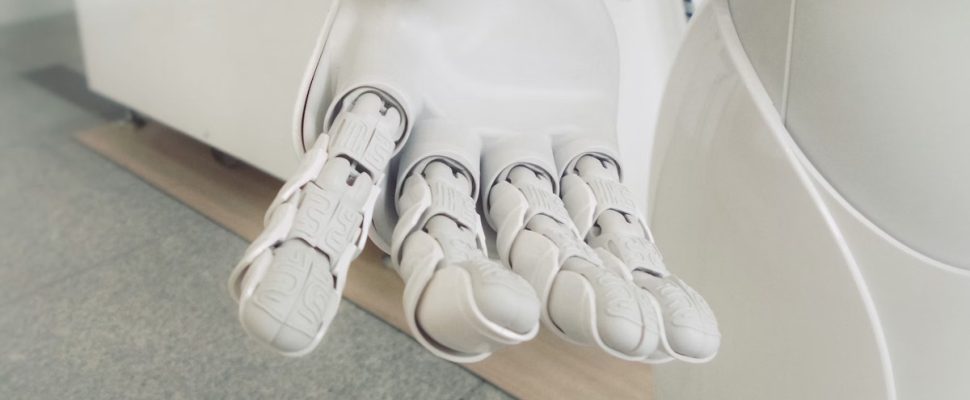

Hong Kong – already Asia’s finance hub and an increasingly robust life science R&D destination – is placing huge bets on becoming the region’s prime location for developing, financing, and scaling robotics technology.
In 2019, Roy Long Hei, founder and CEO of Robocore, returned to Hong Kong from Silicon Valley with a single prototype and a thesis. He had spent years helping manufacturers automate complex production lines before selling that business to a US industrial conglomerate. Now he wanted to take automation somewhere new: out of the factory and into daily life. “In the very early days, that meant carrying a single prototype across the city to demonstrate it to prospective clients.”
That prototype was a compact, screen-faced wheeled robot built on an Israeli open-source platform called TEMI. Today, Long Hei’s company Robocore owns that platform outright, deploys over 15,000 robots across 33 countries, counts Foxconn as a strategic investor, and has a NASDAQ listing on the horizon.
Professor Samuel Au, Founder and CEO of Cornerstone Robotics, is pursuing something similarly ambitious in surgical robotics. Au spent seven years at MIT and eight more at a leading US surgical robotics company before returning to Hong Kong to build the Sentire® Surgical System. The system is already approved by China’s NMPA, in clinical trials at Portsmouth Hospitals NHS Trust, and being tested remotely with Imperial College London. “A technology has no meaning,” Au says, “until it reaches patients and improves their care.”
New Industrial Policy
This is all taking place against the backdrop of Hong Kong’s post-2021 shift towards innovation and technology, and several substantial governmental commitments towards the AI and robotics field. Firstly, a HKD 10 billion (USD 1.3 billion) InnoHK initiative established research clusters in healthcare and AI and robotics at Hong Kong Science Park – drawing in CUHK, the Chinese Academy of Sciences, and partnerships with MIT, Oxford, Cambridge, and ETH Zurich.
Then, a separate HKD 10 billion New Industrialisation Acceleration Scheme was launched to fund smart production facilities, which was followed by a further HKD 10 billion Industry-Oriented Fund channelling private capital into strategic sectors including AI and robotics. The 2025–26 Budget added HKD one billion specifically for a new AI R&D Institute, with Chief Executive John Lee pledging to make AI a core industry for Hong Kong’s development.
The GBA Engine
As in the biotech space, it is Hong Kong’s position as an interface between the Greater Bay Area’s manufacturing ecosystem and global markets that makes robotics investment so compelling. China is now the world’s largest manufacturer of robots, holding roughly two-thirds of global robotics patents, while the Pearl River Delta contains a wealth of industry-relevant infrastructure and expertise. “The GBA’s industrial infrastructure, with suppliers and production facilities within driving distance, allows for rapid prototyping, real-time collaboration, and agile problem-solving, crucial capabilities for deep-tech development,” says Au.
“Hong Kong sits at the centre of the GBA, with deep hardware supply chains, strong engineering talent across Hong Kong and Shenzhen, and close proximity to the regional headquarters of many multinational companies,” adds Long Hei.
However, geopolitics is complicating the picture; Robocore, for example, now runs dual manufacturing, with US-bound units assembled in Taiwan to reduce tariff exposure. “Our objective is not to disengage from a highly developed manufacturing base,” Long Hei says carefully, “but to manage risk intelligently while preserving competitiveness.” It is a tension the whole sector is navigating, and one Hong Kong is arguably better positioned to manage than any purely mainland or purely Western alternative.
Capital Markets
Access to capital has also been critical to the growth of Hong Kong’s robotics industry. In 2023 HKEX introduced Chapter 18C rules permitting tech companies to list with lower commercialisation thresholds. The timing was well-judged: the global robotics sector was moving from research into deployment, producing companies with exactly the right profile: proven technology and real revenues that were not yet profitable.
The results have been dramatic. Horizon Robotics raised USD 696 million in Hong Kong’s largest IPO of 2024, while 12 robotics companies filed listing applications in the first half of 2025 alone. Overall equity financing on the exchange surged 350 percent year-on-year in 2025, at the same time as robotics funding globally hit USD 3.2 billion in just five months, surpassing the full-year 2024 total. “The number of wheel-based robotics like Robocore companies now moving towards IPOs in Hong Kong reflects renewed confidence,” Long Hei notes.
Healthcare Focus
The deepest through line connecting Robocore and Cornerstone is their shared focus on healthcare – and their shared conviction that the real barrier to adoption is access, not technology. Au points to a global robotic surgery penetration rate still below five percent while Long Hei identifies 15,000 US nursing homes as his addressable market. Both are targeting systems under pressure from the same structural force: a chronic and worsening shortage of frontline clinical capacity.
“Our objective is not to replace clinicians, but to extend their reach in settings where demand consistently exceeds supply,” Long Hei says. Au frames it equivalently: his ambition is for robotic surgery to become as routine as MRI – “reliable, widely available, and supported by a network of well-trained professionals” and with the same level of trustworthiness. “I asked every member of the team to apply what I call the ‘mother’s test’: would you trust this robot to operate on your own mother? That question defines our culture,” he adds.
Hong Kong’s robotics story is still early, and its risks are real: unprofitable pipelines, geopolitical headwinds, stiff competition. But the ecosystem being assembled is more than a trend. It is a city, with some deliberateness, putting its institutional weight behind a new industrial identity. “I believe that within the next five years, we will see Hong Kong’s potential unfold, positioning the city as a leading centre for medtech and advanced engineering in Asia,” concludes Au.