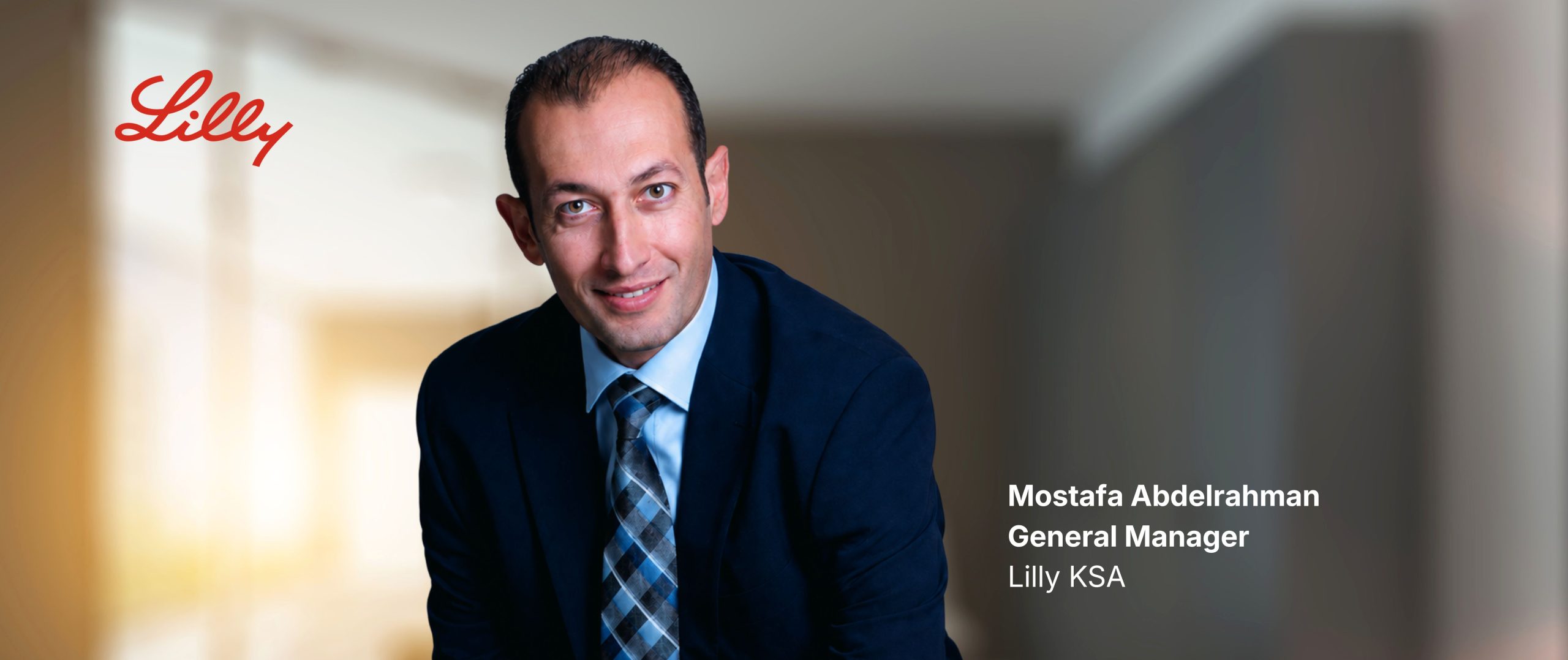
Mostafa Abdelrahman, General Manager of Lilly Saudi Arabia, discusses the company’s evolution from medicine supplier to healthcare partner, supporting Vision 2030 through innovation, public-private collaboration and localisation. He highlights advances in obesity, Alzheimer’s disease and oncology, alongside technology transfer, clinical research and talent development, while outlining priorities to expand patient access, strengthen healthcare capabilities and accelerate the delivery of breakthrough medicines across the Kingdom.
I want us to be recognised not just as a pharmaceutical company, but as a genuine healthcare partner
Could you begin by introducing yourself to our international audience, particularly given your extensive background across different markets and your return to Saudi Arabia just over a year ago?
I am a pharmacist by training, holding a bachelor’s degree in pharmaceutical sciences from Cairo University. I began my career with Lilly in Saudi Arabia in 2008 as a sales representative based in Abha. Saudi Arabia is where my professional journey began and where I developed both personally and professionally. I have been fortunate to build my career with an organisation like Lilly that continuously encourages its people to grow and embrace new challenges.
Over the following 12 years, I progressed through a series of leadership roles across commercial, compliance, and strategy roles across the affiliate. Those experiences gave me a deep understanding of the Saudi healthcare landscape and its evolution.
The US chapter came when I moved to Indianapolis to take on international roles. I first held a business transformation role, led enterprise-wide business transformation projects, and then led omnichannel and digital customer engagement for the international business, working with teams across Europe, Japan, and China. That experience fundamentally shaped how I think about innovation, AI, and digital customer engagement.
In January 2025, I returned to Saudi Arabia as general manager of the Saudi regional headquarter where I had started my career. It felt like coming full circle—returning to the organisation and market that shaped me, this time bringing a global perspective at a defining moment for both the Kingdom under Vision 2030 and Lilly’s own evolution.
Lilly recently marked its 150th anniversary as a global company. How would you describe the evolution of the company from a pharmaceutical supplier to what you now frame as a healthcare and innovation partner?
Lilly celebrated its 150th anniversary this year, and it is a proud moment to be part of an organisation with that heritage: 150 years of research, discovery and development, bringing medicines to patients across the globe. The company was founded on a simple but powerful conviction, that people suffering from disease deserve real medicine, not a shortcut. That founding purpose, that health matters above all else, remains constant.
In Saudi Arabia, Lilly has operated for more than four decades, since 1983, reflecting that same enduring commitment to health and to bringing innovative medicines to patients in need. The purpose has remained the same throughout this journey, but the way we deliver on it has evolved considerably. In the past, our primary role was bringing medicines to patients, and it sometimes took years for treatments approved by the US Food and Drug Administration to reach the population here.
Today, we engage far more broadly. Beyond bringing innovation to Saudi Arabia to serve patients in need, we act as a partner in healthcare transformation: raising public awareness of disease, partnering with relevant stakeholders, generating real-world evidence, and contributing to the broader Vision 2030 Objectives. The medicines themselves have evolved too. Where our focus was once narrower, we now bring breakthrough treatments in obesity, type II diabetes, Alzheimer’s disease, immunology, and, more recently, genetic disease. Sometimes innovation is thought of purely in terms of artificial intelligence and technology, but discovering medicines that help millions of patients live healthier, longer lives is innovation in its own right.
Could you give our international audience an overview of the current portfolio you bring to the Saudi population, and the priority areas within it?
We are investing in breakthrough medicine and innovation in obesity, one of the most pressing healthcare conditions in the Kingdom and globally, and closely tied to diabetes, cardiovascular diseases, and other conditions. We have a strong heritage in neuroscience, with a broad historical portfolio in this area, and we continue to invest in Alzheimer’s disease. The same applies to oncology, where our focus spans several tumor types, immunology, and, more recently, strong pipelines in genomics.
Obesity is a major health challenge in Saudi Arabia. Beyond developing new therapies, how is Lilly working with stakeholders to build the infrastructure, care pathways and financing needed to improve patient access?
Obesity is a unique therapeutic area for several reasons. From a prevalence standpoint, it is one of the most pressing challenges for healthcare systems globally, and Saudi Arabia has one of the highest obesity prevalence rates globally, at approximately 38%, ranking among the top 20 countries worldwide.*
What makes this area particularly distinctive is that obesity has long been misunderstood as a lifestyle issue, with patients stigmatised and told they simply need to exercise more and eat less. In fact, it is a chronic, progressive disease, and its burden is severe and compounding, correlated with more than 200 associated health conditions, including diabetes, cardiovascular disease and liver disease. It also affects workforce productivity and educational outcomes. These are not future risks, they are present and costly realities touching millions of families today in Saudi Arabia.
As a medicines company, we play an active role here. We brought innovative anti-obesity medicine to Saudi patients among the first markets globally, and given the scale of the challenge, this requires broader ecosystem shaping to pave the way for these treatments to reach the patients who need them. We have partnered with government stakeholders on a nationwide disease awareness campaign to shift the narrative around obesity and help the population understand it as a disease that can be managed. We are also partnering to establish clinical care pathways, educating healthcare providers, and, most importantly, generating data and real-world evidence to support policy makers in their decisions.
One example is a landmark study by Whiteshield we commissioned, published at the Global Health Exhibition last October, which quantified the economic and societal impact of obesity in Saudi Arabia. According to the study, if access to anti-obesity medicine were scaled by 2030 to reach more than 50 percent of those living with obesity, the cumulative saving to the healthcare budget between 2026 and 2030 could reach 1.8 billion USD. It also indicated that this has the potential to increase gross domestic product by one percent, to raise life expectancy from 74 years to 75.2 years, with more than 3 years spent in good health, and to add more than 78,000 Saudi nationals to the workforce through improved productivity. These figures illustrate the scale of benefit possible when the full burden of obesity is properly addressed.
As a leader in Alzheimer’s disease research, how is Lilly helping address the needs of the approximately 130,000 people affected in Saudi Arabia, particularly through your partnership with King Faisal Specialist Hospital and Research Centre?
Alzheimer’s is another unique therapeutic area, and timing is everything. The earlier a patient can be identified as living with Alzheimer’s, the earlier intervention can begin, and the better the outcome. For decades, the most critical bottleneck has been diagnosis itself.
Our agreement with King Faisal Specialist Hospital centres on florbetapir, a positron emission tomography imaging tracer capable of detecting amyloid plaques in the brain, the protein accumulation that underlies mild dementia and Alzheimer’s disease. Amyloid PET is the gold-standard for diagnosing Alzheimer’s Disease. Under our agreement, King Faisal Specialist Hospital will localise the development, manufacturing and distribution of this tracer within the Kingdom, building a sustainable diagnostic infrastructure rather than a one-time solution. This has a direct impact on patients, enabling earlier and more accurate diagnosis, which opens the door to faster intervention and helps prevent disease progression for many.
Public-private partnerships appear central to Saudi Arabia’s healthcare agenda. How are you working with stakeholders in this regard, and what opportunities do you see?
Vision 2030 places healthcare transformation at the centre of the national agenda, and progress has been remarkable across several dimensions. The Saudi Food and Drug Authority is working to bring innovation to the market earlier, there is significant momentum around the digitalisation of health services and quality improvement, and considerable work is underway to expand patient access to medicine. Under Vision 2030, there is a deliberate and constructed direction toward a more modern and sustainable healthcare system.
As a pharmaceutical company, we position ourselves not as a supplier of medicine but as a healthcare partner, and there is considerable alignment between our strategy and the direction of Vision 2030. As the country focuses on reducing the burden of non-communicable disease, our own focus on obesity, diabetes, Alzheimer’s and genetic disease speaks directly to that priority. Bringing innovation early remains central to our approach. At the same time, the country continues to advance its clinical trial ecosystem, with the Saudi National Institutes of Health, the Saudi Food and Drug Authority, and a growing number of centres now capable of conducting phase II and phase III clinical trials, an area we are exploring further to bring more trials to Saudi patients. We also continue to pursue technology transfer where relevant, as with the Alzheimer’s diagnostic agreement, to help build local diagnostic and research capability. In general, our role as an active healthcare partner extends beyond bringing medicine quickly to patients, to engaging with policymakers on evidence-based solutions, generating real-world evidence, and supporting clinical trials and technology transfer wherever needed.
Localisation is another significant priority for the Kingdom. How does Lilly contribute to this agenda?
Localisation is one of the most important priorities under Vision 2030, and we are committed to contributing to it in a meaningful and multidimensional way. When people think of localisation, manufacturing is often the first thing that comes to mind, and rightly so — it is a vital national priority. But localisation, in my view, is a broader concept that takes many forms, and Lilly is investing across several of them. Technology transfer is localisation: we’ve brought capabilities like the florbetapir tracer to a local institution, enabling it to produce and distribute a diagnostic agent here in the Kingdom. Clinical trials are another dimension we are actively exploring so that Saudi patients can be part of testing the medicines developed for them. And talent development is, to me, one of the most important forms of localisation of all — building a strong base of Saudi professionals within our organisation who will go on to lead the next generation of this industry. Today, Saudi nationals make up more than 70% of our workforce, up by around 20% points over the past few years — a trajectory we are proud of and firmly committed to continuing.
What opportunities do you see to expand access to your medicines, and what has your experience been in bringing innovation to patients here?
Access to innovation is an area where I see real opportunity. Once a product is registered, it becomes available in the private sector, and we’ve seen strong momentum there in bringing breakthrough medicines to patients quickly. The public sector pathway naturally involves a more comprehensive set of steps, given the scale and responsibility of ensuring sustainable access across the entire population. The opportunity I see is to build on the momentum we’ve already established in the private sector and work even more closely with our government partners to quickly broaden the patient base who can benefit from these innovations, so more Saudi patients can access breakthrough medicines sooner. This is a shared goal, and one where I believe Lilly can continue to be a constructive partner to the Kingdom.
Looking ahead, what are your objectives for Lilly in Saudi Arabia over the coming years?
When I think about where I want Lilly Saudi Arabia to be in two to three years, I think about three things.
First, I want us to be recognised not just as a pharmaceutical company, but as a genuine healthcare partner — one that has contributed meaningfully to the Kingdom’s capability, its evidence base, and its policy landscape.
Second, I want to accelerate the pace at which we bring medicine and innovation to patients in Saudi Arabia, while improving access, speeding reimbursement, and strengthening disease awareness — particularly for conditions where greater understanding of the underlying disease burden can help ensure patients receive the recognition and care they deserve.
Third, on a more personal note, I would like to leave a lasting impact when I eventually move to my next role: deeper leadership, stronger capability building, the right culture, and ensuring that excellence is not simply a value on the wall but something visible in every decision made each day.
On a more personal note, what leadership approach do you bring to your teams, having worked across so many different markets and organisations?
First is creating an inclusive culture where everyone feels welcomed and respected, so that they can bring out the best in themselves and in each other. Second, we operate in an extremely busy world, both internally and externally, and without the discipline to prioritise, focus, and make trade-offs, including saying no when necessary, it becomes difficult to move anything forward meaningfully. Third, elevating performance means consistently pushing ourselves and our teams outside our comfort zones, because real learning and development happen there rather than within the boundaries of the familiar. I often use the analogy of a gym, where a coach asks you to lift heavier weights than you are used to. There is discomfort at first, but that discomfort is what builds strength over time, and the same principle applies to developing people and elevating performance within a team.
* NCD Risk Factor Collaboration (NCD-RisC), Worldwide trends in underweight and obesity from 1990 to 2022, The Lancet, 2024 — data.worldobesity.org/rankings